18 April 2013

Traffic Synchronization

Interesting article in the NYT the other day:  To Fight Gridlock, Los Angeles Synchronizes Every Red Light:

Now, in the latest ambitious and costly assault on gridlock, Los Angeles has synchronized every one of its 4,500 traffic signals across 469 square miles — the first major metropolis in the world to do so, officials said — raising the almost fantastical prospect, in theory, of driving Western Avenue from the Hollywood Hills to the San Pedro waterfront without stopping once.

[....]
The system uses magnetic sensors in the road that measure the flow of traffic, hundreds of cameras and a centralized computer system that makes constant adjustments to keep cars moving as smoothly as possible. The city’s Transportation Department says the average speed of traffic across the city is 16 percent faster under the system, with delays at major intersections down 12 percent. 

Without synchronization, it takes an average of 20 minutes to drive five miles on Los Angeles streets; with synchronization, it has fallen to 17.2 minutes, the city says. And the average speed on the city’s streets is now 17.3 miles per hour, up from 15 m.p.h. without synchronized lights.

I used to work for a startup that came up with a product very similar to what is described here, except that this product was a computer networking system.  We handled various Ethernet and T1 interfaces, and, the special-sauce behind our product was that our product synchronized network traffic that required Quality of Service (QoS).  I was the architect of the signaling protocol that facilitated all of this (and I contributed in many other ways too).

This was an interesting system.  Parts of the system used a hard-real-time OS, parts of the system involved a {thing} that looked a lot like an enterprise-class softswitch.  Not a day went by at this job in which I wasn't working on some interesting problem.

Our system worked really well too:  we could turn the jitter buffers essentially "off" in the various video/audio codecs that were on the endpoints that we used, and we could see very clearly that our system never dropped any packets.....even at nearly 100% load and wire-speed.

Unfortunately, we were a little bit before our time, and the market for this sort-of "near-perfect QoS" gear never really took off.

Still, when somebody like Bob Metcalf strolls through your company's lab and says that the technology that you've been working on is "really, really cool", that makes for a good memory.

There is never a dull moment in high-tech.

13 March 2013

Bring Back Google Reader

My sentiments exactly:

http://bringgooglereaderback.com/

{sigh}

In the past few months, my favorite replacement for iGoogle has turned out to be igHome.  I guess I'll have to find a replacement for Google Reader now too.

Bleh.

22 February 2013

Retransmission Dampening

A certain network protocol that I work with can spew a lot of traffic.  Staggering amounts, actually.

I only have limited control over this traffic.  It just shows up (sometimes as if fired by a Gatling gun), and code that I help maintain on a certain server has to deal with it.   When the traffic isn't handled in a timely manner, people get upset and the phone starts ringing.

Recently, after witnessing our server starting to have difficulty handling a certain burst in traffic, I started to think to myself "how are we going to improve?".  I came up with a variety of ideas.

One of my ideas went as follows:


It is computationally non-trivial to unpack everything in every PDU that arrives at the server.  Under normal operations, everything is fine, and there are plenty of CPU resources for this sort of thing.  However, during heavy traffic loads, my data suggests that unpacking all of these PDUs is something that I need to pay attention to.

And....one of the problems is that the {things} that are sending our server all of these PDUs almost seem to be impatient.  Some of these {things} seem to operate in the following way: 

  1. Send a PDU with a request in it
  2. Wait an infinitesimal amount of time
  3. Have you received a response yet?  If "yes", we are done!  However, if "no" then goto step 1.
The problem I am seeing when I analyze the traffic is that I see a fair number of re-sent PDU requests.  Our server is handling the requests, but perhaps not at the rate that these {things} on the network would like.  All that these re-sent request PDUs do in these busy periods is add more load onto our server, which is unpacking the received PDUs as quickly as it can and then doing work.

But...when I look at the guts of this protocol, I believe that I see a non-trivial (but not difficult either) way of limiting these re-sent packets.  The code that I have in mind won't actually have to entirely unpack all of the PDUs in order to figure out which packets are re-sent packets and which packets are valid new requests.

Here is the thing that I have in mind:
  1. Under normal operations, everything works as it usually does.
  2. A "retransmission dampening filter" (RDF) will always be running.
  3. The RDF will let new PDUs into the system with no restrictions.
  4. In a CPU-efficient way, the RDF will be able to detect PDUs that are retransmissions.  If a PDU has been re-transmitted by the network {thing} without having waited {N} milliseconds, then the packet will be dropped.  This will spare the rest of the system from having to unpack the entire PDU, which, again, takes some CPU time.
I think that the nice part about this scheme is that it pretty much maintains itself.

However, before I go off an write some code to implement this, I decided that I wanted to run a simulation using some Real World data to see how much of an effect on overall traffic this scheme would have if the system was running with a {1, 2, 3} second minimum.

So, I threw together a simulator, and here are my results:


So, um, yeah....obviously I'm going to write some code soon to implement this.  Of course, I'll make my code tunable, but I'm pretty sure that the default will be to enforce a minimum 1-second retransmission minimum.  This should be both a fun project, as well as something that will really help the server that I help maintain!

21 February 2013

Nam-shub of Enki

It is the Nam-shub of Enki

(or, at least it is for Mac OSX systems...)

18 February 2013

08 February 2013

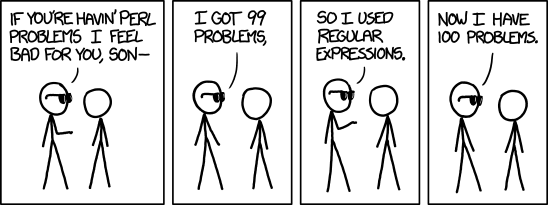
Pondering the different reactions from the two /^J.*Z.*?$/s


http://xkcd.com/1171/


Why do I get the feeling that jwz is laughing right now?

Also, why do I get the feeling that sometime today, somebody might try to explain to Jay-Z a certain technical joke -- maybe he'll smile at the joke -- and then he'll get back to making another million dollars...

03 February 2013

Praise for Tomas Holmstrom

Like every other hockey fan, I'm pretty irked with the NHL right now (thanks for the lockout, idiots....). But, this doesn't prevent me from admiring the truly remarkable career of Tomas Holmstrom, who retired recently.
Take a look at some highlights:


I think that every goalie in the NHL was glad to see Holmstrom go -- he drove them CRAZY. He scored most of his goals 3-4 feet from the net -- most of these were redirections and "garbage goals". He made a fine art out of these goals, but of course he had to work really hard and take a TON of abuse for each one.

Can you imagine having a job in which it is your task to stand in front of the goalie, trying to obscure his vision while a giant defenseman tries to move you out of the way?  Oh, and then, what happens next is that some guy shoots a small hard rubber puck in your general direction at around 100mph....and while the defenseman is seriously abusing you, it is now your job to "tip" the puck with your stick, hoping to direct the puck into the net.   This is what Holmstrom made into art.

I'm a hockey fan, and I cheer for the players more than I do for the teams. I'll miss seeing Homer out on the ice.